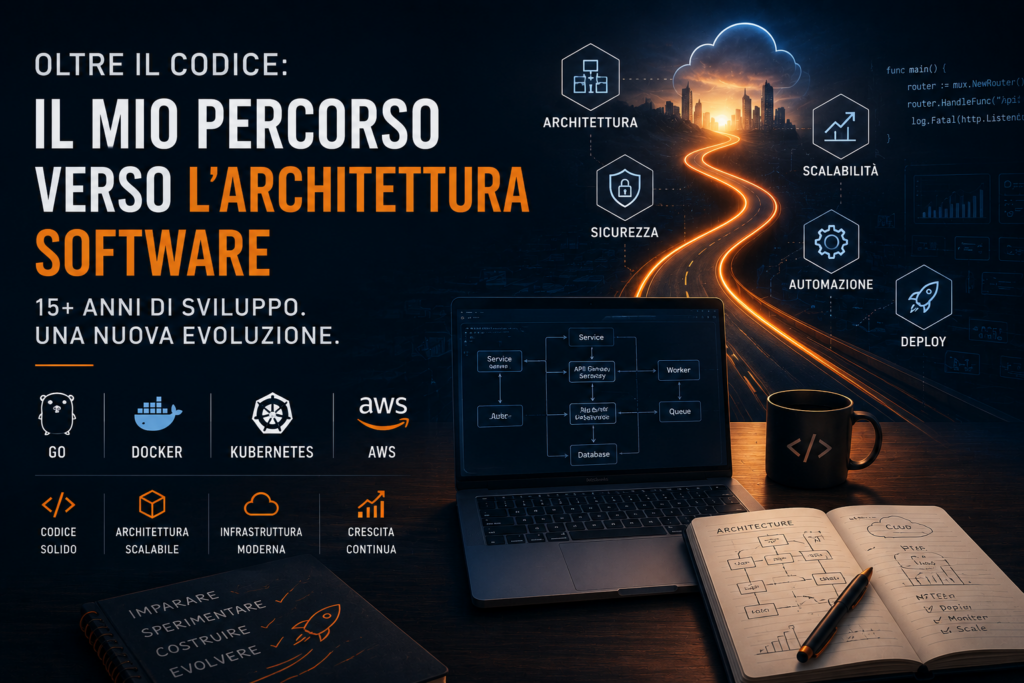
If there is one thing I have learned in over fifteen years of software development, it is this: writing code is only one piece of the puzzle.
For a long time, my focus was building web applications, enterprise portals, custom tools, and WordPress plugins. My goal was always clear: deliver stable, maintainable software that solves real-world problems.
Over time, however, I realized that there is a massive world operating behind every application. Software does not exist in a vacuum. It lives within an infrastructure, talks to other services, needs deployment, requires monitoring, and must be architected for scale.
That realization triggered my professional evolution.
Broadening My Perspective, Not Changing Careers
Some might look at my current focus on Go, Docker, Kubernetes, and AWS and assume I am moving away from PHP.
It is quite the opposite.
PHP remains the bedrock of my career and experience. What is shifting is my lens. Today, I do not just want to write apps. I want to master how they are architected, deployed, and maintained in modern engineering ecosystems.
Go: Shifting the Paradigm
Among the technologies I am diving into, Go has stood out the most. Its core philosophy runs counter to many modern programming languages.
Fewer abstractions. Less complexity. Pure simplicity. High readability. Raw performance.
Deep diving into Go means tackling core systems-level concepts:
- Goroutines
- Channels
- Select statements
- Context propagation
- True concurrency management
These topics feel worlds apart from traditional web development at first. Yet, once they click, they fundamentally rewrite how you design applications. What I appreciate most about Go is how it forces you to write clean, straightforward, and maintainable code—a mindset I am now actively embedding into my PHP projects as well.
Docker: Thinking Outside the Codebase
Docker has completely reshaped my engineering workflow. For years, I approached software primarily from a code perspective. Today, I architect the entire environment where that code breathes.
Containerization makes applications reproducible, isolated, and seamlessly deployable. Right now, my focus is on advanced container mechanics:
- Multi-stage Dockerfiles
- Docker Compose orchestration
- Container networking
- Volume persistence
- Isolating databases and backend services
Docker is not just a DevOps tool. It is a paradigm shift in how we manage the entire application lifecycle.
AWS: Demystifying the Cloud
To ground this operational knowledge, I am currently on a structured path toward the
AWS Certified Solutions Architect – Associate certification.
This is not a resume-padding exercise. For me, it is the ultimate way to understand how modern, resilient infrastructures are engineered. It teaches you which services fit specific scenarios, and how to navigate architectural trade-offs when designing reliable systems at scale.
Studying AWS means mastering structural concepts:
- High Availability
- Fault Tolerance
- Cloud Networking & Security
- Distributed Storage
- Load Balancing
Every single one of these elements is expanding my design horizons.
Curiosity as the Growth Engine
Learning does not stop at official curriculum boundaries. I dedicate a significant portion of my free time to informal learning—diving into tech channels covering Terraform, Ansible, advanced cloud architectures, and real-world post-mortems.
The goal is not always immediate implementation. Sometimes, it is about observation. Seeing how other engineers think and break down problems is the fastest way to grow.
An engineer does not need to know everything. But we must keep our curiosity alive.
Moving Toward Software Architecture
If I had to summarize my current trajectory in a single sentence, it would be this:
I am evolving my development profile toward a holistic software architecture mindset.
This does not mean putting down the keyboard or stopping writing code. It means understanding the context of that code. It means mastering how applications are designed, deployed, monitored, and scaled over time.
To me, this is the natural path of growth for anyone who truly loves building software. And that is exactly where I am investing my energy.
Final Thoughts
Every new technology I explore adds a piece to the puzzle. It doesn’t replace the foundation I have built over the last fifteen years; it completes it.
My ultimate goal remains unchanged: engineering high-quality software. But today, I approach it with a wider lens—one that starts at the lines of code and stretches all the way to the infrastructure that runs it.
Modern software isn't built by mastering a single language. It is built by understanding how all the moving parts work together.