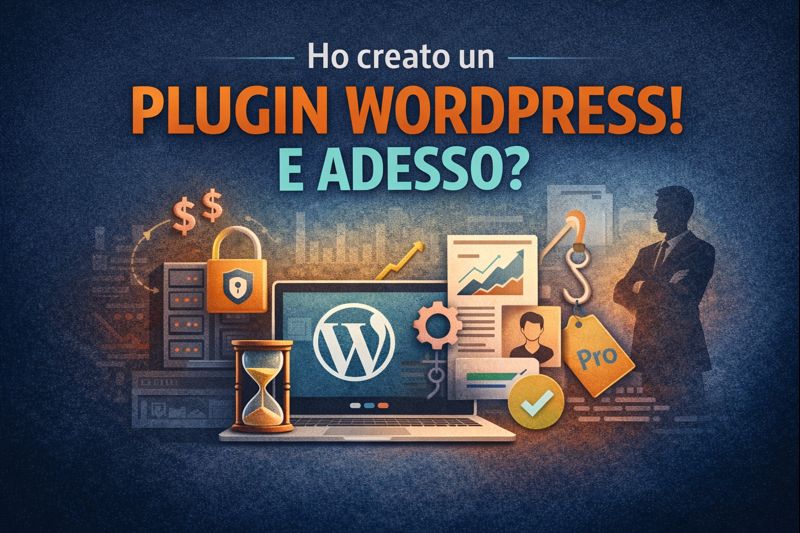
Building a WordPress plugin is deeply rewarding. Seeing it work, solve a real problem, and integrate with a complex ecosystem such as WooCommerce is one of the reasons I enjoy this profession.
But when a plugin stops being only a technical experiment and begins to become something more, an inevitable question arises:
what comes next?
This article stems from my work on Reseller Manager, a WooCommerce add-on I developed to manage reseller accounts, custom price lists, and dedicated discount rules.
Rather than merely describing its features, I want to explain what lies behind it: design, technical decisions, and the complexity that emerges when a project is intended to grow.
The problem to solve
Many WooCommerce stores share similar requirements:
- managing resellers or commercial partners;
- applying dedicated discounts;
- assigning product-specific prices;
- restricting access to selected functionality.
These needs are often addressed through combinations of different plugins or partial solutions.
Reseller Manager was designed instead to provide a single management layer dedicated to resellers, integrated natively with WooCommerce.
What Reseller Manager does
Reseller account management
- registration through a front-end shortcode;
- dedicated login for approved resellers;
- a custom WordPress role.
Manual approval
- new accounts are disabled by default;
- an administrator enables them from the back end;
- an automatic email is sent after approval.
Price and discount management
- a global percentage discount for each reseller;
- custom prices for individual products;
- the option to display either the discounted catalogue price or the full price with the discount applied at checkout.
WooCommerce integration
- rules applied to the shopping cart;
- compatibility with standard WooCommerce flows;
- automatic checks for WooCommerce availability.
In short, it is a system that controls who can see what, and at which price.
The plugin works. What would it take to sell it?
This is the question that changes the perspective entirely.
As long as a plugin remains an internal tool, the focus is technical. Once it is considered as a product, new responsibilities emerge:
- long-term reliability;
- continuous updates;
- user support;
- protecting the value of the software.
You are no longer simply developing code. You are building an ecosystem.
From plugin to product
Selling a plugin means ensuring that customers can install and activate it easily, receive updates, and obtain support. These requirements call for deliberate architectural decisions from the outset.
Premium licensing
A premium version is not merely one additional feature. It requires:
- a licence generation and validation system;
- a remote verification server;
- a secure mechanism that makes updates available only to authorised users;
- strategies to prevent abuse.
In practice, this means developing an infrastructure alongside the plugin itself.
Managing updates
Customers who pay for a product expect regular updates that do not break their sites and remain compatible with WordPress and WooCommerce. Every release becomes a responsibility.
Building a sales network
Writing the plugin is only one part of the work. A clear landing page, documentation, distribution channels, and pre-sales and after-sales support are also required.
This is where the difference between being a developer and being a product developer becomes clear.
Why I am sharing this journey
For companies: to demonstrate the approach I use when developing custom solutions.
For developers: to start a discussion about licensing, updates, and distribution, and to explore potential collaborations.
Would you like to discuss it?
If you work with WordPress, WooCommerce, or digital product development and would like to exchange ideas or collaborate, get in touch.