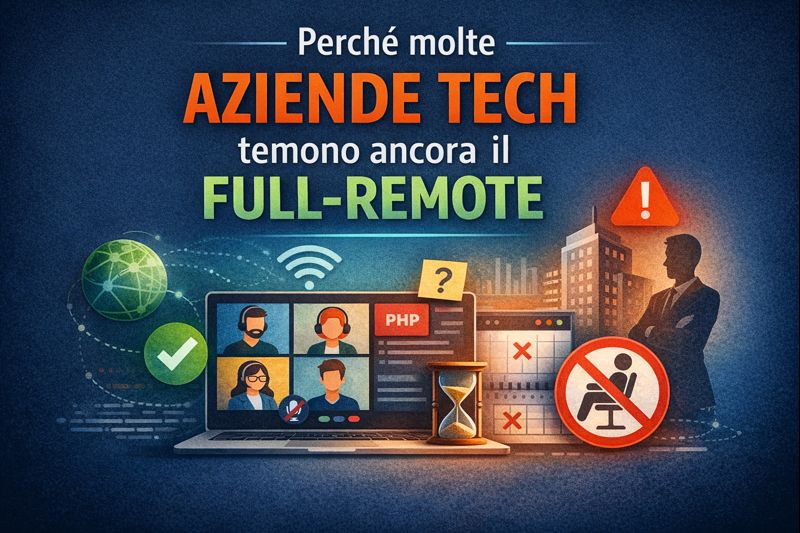
In 2026, in a digital and connected world, many technology companies still regard fully remote work with suspicion.
This issue affects me personally. For me, working fully remotely is not a convenience; it is a necessity connected to a mobility disability that prevents me from commuting to a physical office every day. Yet when this requirement comes up during an introductory interview, the conversation often ends.
The question I keep asking—and want to share—is simple:
why is fully remote work still so difficult to accept?
Full-remote work is not the problem
Throughout my career, I have worked with many open-minded, forward-looking organisations, delivering complex projects while meeting deadlines, objectives, and software quality standards.
In those environments, physical distance was never a limitation.
The work was assessed on what genuinely matters:
- results;
- reliability;
- communication;
- code quality.
The problem, therefore, is not remote work itself.
The problem is trust in the model.
Physical presence does not equal productivity
Many companies continue to associate physical presence with:
- control;
- productivity;
- engagement.
But technical work—software development in particular—does not operate that way.
Writing code, designing architectures, and solving complex problems require:
- concentration;
- autonomy;
- accountability.
None of these qualities depends on having a desk in an office.
When full-remote work becomes an invisible barrier
For people who, like me, cannot commute every day, rejecting fully remote work is not simply an organisational preference. It becomes a real barrier.
A barrier that:
- limits access to opportunities;
- compounds an existing condition;
- excludes capable professionals.
This raises a broader question:
are technology companies genuinely ready to talk about inclusion if they cannot adopt such straightforward organisational solutions?
Effective companies have already moved beyond this debate
Interestingly, the companies with which I have worked most successfully are often those that:
- assess people against objectives;
- communicate clearly;
- organise work in a structured way;
- do not rely on visual supervision.
In these environments, fully remote work is not a problem to manage but a natural operating model.
Full-remote work as an opportunity, not a concession
Accepting fully remote work does not mean doing someone a favour.
It means:
- accessing a wider talent pool;
- retaining skilled professionals;
- creating more flexible and inclusive workplaces.
In technology, where expertise matters more than physical presence, this should be an obvious choice.
Conclusion
Perhaps the real question is not whether fully remote work is effective.
The question is: are we genuinely ready to rethink how we work?
Digital work does not need walls to function.
It needs trust, organisation, and vision.